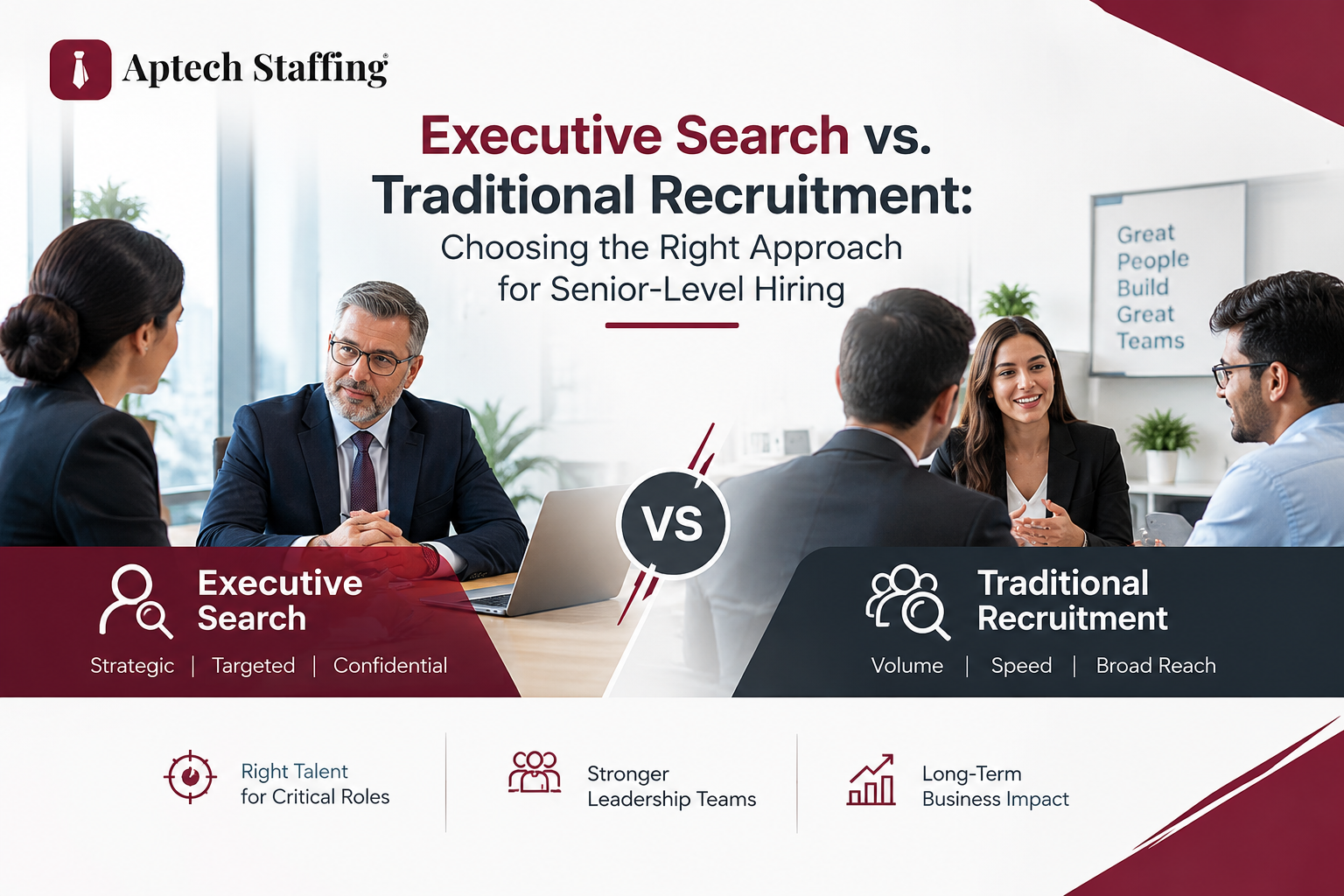
Recruiting a senior leader is no ordinary job. Who you select can impact strategy, budgets, customers and the experience of hundreds of workers. Once that responsibility has become real, a question that many will know is asked: executive search or conventional recruitment?
Both approaches do not have a set of fixed winners. The best selection will be based on the role, the talent available, the sensitivity of the search and the support they will require by your organization. There are two important steps in recruiting for Aptech Staffing: first, identify the business challenge and then select the appropriate recruitment strategy.
Know each Approach and what it Entails
Recruitment is an old process that includes a wide variety of positions and processes. Internal recruitment or advertising on databases and referrals and direct outreach to agencies can be used to recruit employees. Third party recruiters can do contingency arrangements, that is, they get paid when the position gets filled – but there are other options.
Executive search usually requires a specific engagement to look for and evaluate top executives for a particular requirement. SHRM recognises that its strategic search focus differs from the general recruitment and that in some instances, executive search is conducted on a retained basis.
People often mix-up the service with its service model. There is no guarantee that the sourcing and evaluation will be excellent under a retained agreement, and a contingency recruiter can be thoughtful in sourcing and evaluating. Review scope of work as it exists.
Compare the differences in practice:
| Decision Factor | Executive Search | Traditional Recruitment |
|---|---|---|
| Industry focus | Strategic leadership positions | General operation & management positions |
| Outreach initiatives | Candidate outreach, targeted research and discreet approaches | Advertising, referrals, databases and outreach |
| Engagement | Often retained & exclusive | Internal, contingency, hybrid |
| Evaluation | Usual, more in-depth evaluation of leadership skills | Depends on agreement on scope of services |
| Resembling situation | As the leadership transition is confidential or complex | The role is clearly defined and talent is easily accessible |
AESC says all the firms that belong to it carry out executive search on a retained, exclusive basis. That’s its membership requirements, not all providers who use the executive search appellation.
Determine the Amount of Business Risk
Talk first about what would happen if the appointment doesn’t work out. Will it have an effect on only one department or will it impact revenue, investor confidence, compliance or a complete transformation program?
If a company is making a change in its CFO position during an acquisition, they might require a lot of market research and leadership evaluation. A business with an established business management with a professional regional manager will have a better idea of who they’re looking for and easier access to a talent pool to hire from.
This is a good principle to start an appropriate internal discussion:
Select the hiring process based on the implications and not the name.
Consider Which Candidates Are Actively Looking
An advertisement will be posted for some suitable leaders to apply. Others may find success in their existing organization, but not be ready to speak in public about what they might look for.
When an employer requires deliberate market mapping and confidential conversations with these professionals, it can be valuable to use executive search. AESC refers to a research based process that incorporates knowledge from industry, networks and a structured evaluation.
Passive candidates can also be recruited using traditional methods. The only question is whether or not your selected provider has the time, relationships and mandate to dig deep into the relevant market, rather than just reaching out to those they already know.
Consider Confidentiality as a Process
Confidentiality is important in the replacement of an incumbent, entering into a new market and discussing sensitive commercial plans. Candidates must also be assured that exploring an opportunity won’t jeopardize their current job.
Inquire about the way information will be disseminated, who will be able to see candidate records and when references will be called. Determine authorization needs prior to outreach.
One of the points AESC makes in its candidate guidance is for employing a “no” approach when it comes to sharing credentials or contacting candidate-provided references. These safeguards are helpful when checking out any recruitment partner.
A confidential label that is not accompanied by documented procedures and consistent behaviour is of little meaning.
Compare Costs, Not just Fees!
Hiring a cheap search can end up costing a lot of money if it results in poor quality candidates or if there are a lot of rehires. Likewise, it would be hard to justify the cost of a retained assignment which doesn’t need the extra research and advisory effort.
Ask for written descriptions of:
- Deliverables, milestones and reporting.
- Fees, stages of payment and extra costs.
- Exclusivity, Cancelation and replacement policies.
- Methods of assessment and reference checking.
- Entry limitations with regard to target candidates.
Don’t believe that a “one size fits all” solution is always going to be quicker. The timelines are dependent on the market conditions, the compensation, and stakeholder availability, as well as the complexity of the appointment
Evaluate Leadership Through Evidence
Regardless of your choice, be sure to establish success criteria prior to interview. Outline the choices that the person will make, the difficulties they will face and what they will achieve in the first 12 months.
Utilize job interviews, business discussions and references that are relevant to the examination of judgment, collaboration, ethics and change leadership. Have candidates differentiate between individual and team effort.
Don’t just assume the behaviors that your organization should be looking for, measure for cultural similarity. A constructive challenging of the current thinking may be more useful than a familiar feeling.
Select the Partner Behind the Label
Ranking of the best recruiting companies in USA is the initial step in the search process and may introduce possible partners, but ranking doesn’t mean suitability. Discuss who will be doing the assignment, what similar assignments they have done and how they would deal with any ‘difficult feedback‘.
The top staffing agencies USA like Aptech Staffing in the operations hiring arena may not be executive specialized. Similarly, leading staffing agencies in USA can have a wide scope but not fulfill your specific leadership needs.
Compare the largest staffing agencies in USA to smaller specialists in terms of relevant experience, researcher involvement, communication and candidate access. Siz is not the answer to those questions.
Take Right Decision with Confidence
The main premise of Aptech Staffing is: first the job, then the method. Traditional recruitment might be appropriate for a readily available candidate base and recognized requirements. Confidentiality, limited leadership skill or strategic implications may warrant more than a cursory investment in executive search.
Make sure that expectations are documented, standards for assessments are agreed and decision-makers are kept engaged. The purpose is not just an accepted bid. It is a leader that is capable of doing results and earning the trust of the organization.
Frequently Asked Questions (FAQs)
What is the difference between Executive Search and Traditional Recruitment?
Executive search is used to find and evaluate senior managers, for strategic or sensitive roles. Often includes targeted market research, confidential outreach and more in-depth leadership assessment. Traditional recruitment encompasses a larger scope of job postings and includes a wider variety of job posting methods, including job advertising, referrals, databases of potential candidates and direct job posting approach.
When should employers consider hiring through executive search in their quest for top talent?
Executive search can be a choice for employers if a position involves a confidential change, is a critical one to fill because of its business impact or is a position that lacks a lot of leadership skills. It is also useful when there are not actively looking job opportunities and a delicate and well-tuned approach is required.
Is it possible to recruit for leadership using traditional methods?
Yes. Traditional recruitment is suitable in situations where job requirements are clearly defined, candidates are suitable and they have an effective internal assessment system. The decision should be based on the nature and nature of the consequences of appointment, not the job title.
What are the differences between Executive Search fees and traditional recruitment fees?
Retained arrangements are commonly used in executive search, where fees are paid based on the stages of completion. While some traditional recruitment agencies will take contingent fee arrangements (payment post placement), there are alternatives. Before signing an agreement, employers should check deliverables, costs, exclusivity, cancellation and replacement clauses.
While selecting a senior-level recruitment partner, what should employers take into consideration?
Employers should consider relevant industry experience, completed leadership searches, access to candidates, assessment techniques, and confidentiality and communication norms. When assessing the best recruiting firms in USA, inquire about who will be in-charge of the assignment and the way they will measure the candidates against the company’s business targets.