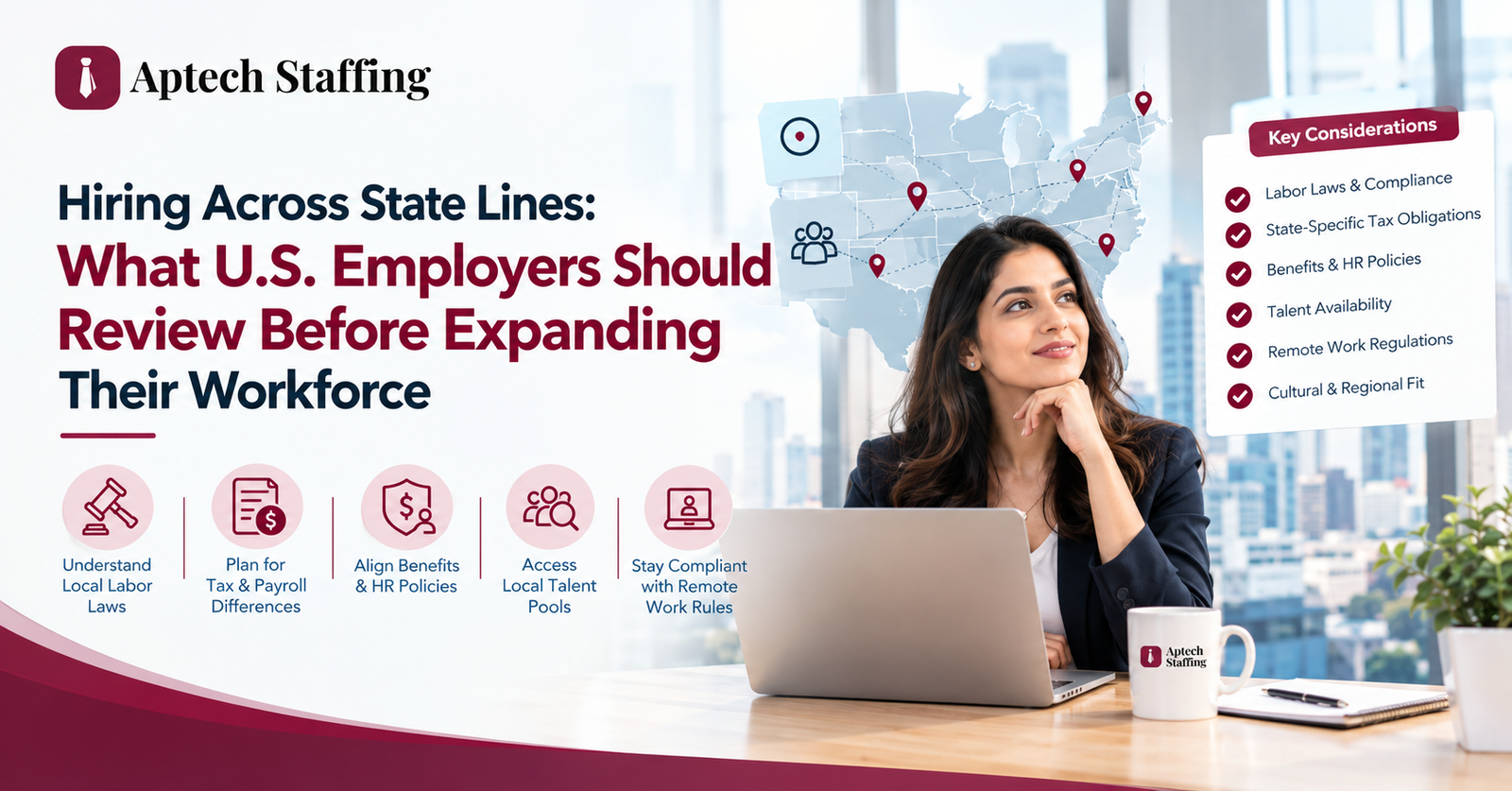
Working with workers from another state can unlock access to great talent, new markets and greater business expansion. It can also bring with it unassuming obligations. A remote worker from another state could result in new payroll, tax, workers’ compensation, wage, leave and business filing needs.
The answer is, don’t make multi-state hiring a hassle! Employers can add staff members with ease and security in their day-to-day operations with accurate information and proper planning and with the right staffing partner.
Start at the Work Location
The first question is easy: Where is the employee going to physically do the work? The answer could be different from the address of the company, the manager of the employee and the address given on an application.
The employment rules, tax rules, wage standards and leave rules that apply to an employee typically depend on where they actually work. It is particularly relevant for teleworkers that work from home, travel frequently or divide their time between jurisdictions.
When posting a role, an employer should ensure that they document where the desired role is to be filled, and whether or not it can be filled from other states. HR and payroll departments, legal professionals and managers can assess the proper requirements at the outset by removing the location data.
Review Business Registration
The company could need to register or qualify or both, to do business in a new state if they employ an employee there. The requirements vary by state, and can depend on the employee’s role, work activity and business presence.
Employers should check for local registration requirements, such as a state business registration, an employer account, an unemployment insurance account, etc. Delaying until the initial payroll deadline can cause unnecessary delays and perhaps penalties.
They will help determine what applies if the target state is not familiar to you or if you do not have a legal or tax professional familiar with the target state. It is also important for businesses to have the information regarding each state’s registration and renewal dates and the corresponding contacts.
Calculate and file payroll and taxes
The payroll system should be set up for the employee’s working location. This could include income-tax withholding, unemployment insurance payments, disability payments, local taxes and state-specific reporting.
The state income tax obligations typically follow the employee, rather than the company, where the work is done. Also, it’s important for employers to be aware of the implications of a multi-state schedule or temporary work in a different state on withholding.
Ensure that payroll has the address, tax setup, pay frequency, deductions and reporting set up before the employee receives his first paycheck. Employers can choose to work with a payroll provider that can process payroll in multiple states, but they must still provide correct information and be aware of changes.
Check Workers’ Compensation
Before starting to work in another state, workers’ compensation coverage needs to be checked. There might not be a policy that covers all locations and all type of work.
Call the insurance carrier to verify coverages, registrations, classification codes and reporting requirements. This is especially relevant if they are travelling to customers’ premises, on duty equipment, from state to state and in higher risk areas.
Don’t presume to say that an out in the field employee when working from home does not pose a work site risk. Employers should have an understanding of injury procedures, equipment, ergonomic issues and reporting.
Compare Employment Laws
Some states may also have specific overtime, meal and rest break, employee classification, minimum wage, contribution, expense reimbursement, final pay, wage notice, family leave and paid sick leave requirements. Additional requirements may be imposed by city and county regulations.
Check the company handbook, offer letters, and employment postings as well as payroll procedures and training for managers to see if they match the employee’s state. One policy that works may not work in another place.
Also look at regulations addressing pay transparency, salary history, restrictive covenants, background checks, personnel records and required workplace notices. Multi-state compliance is an on-going project, not a one-time job, because employment laws are constantly evolving.
Evaluate the Local Talent Market
While compliance is essential, it is also crucial to the local labor market to be successful in hiring. There can be significant differences across metropolitan areas and states in pay expectations, availability, competition, commute patterns, skills supply and candidate preferences.
The same role on one city might be filled in the next in a different city in just a few weeks. Before determining the recruitment plan, employers should check the salary rates in the area, the remote-work requirements, and the benefits and hiring deadlines.
The best staffing & recruitment agency in USA like Aptech Staffing can offer important synopsis from the market. An informed partner is aware of local candidate communities and can help determine if the job description, salary and time frame are feasible.
Consider a Staffing Partner
Following an initial expansion, hiring through a staffing company in USA can be much easier, particularly if a company requires just a few workers in the new state. The agency might be the employer of record for payroll, tax administration, workers’ compensation, onboarding and some other employment requirements.
This can offer rapid and adaptable solutions whilst the company assesses the market. But employers must be wary of the deal, as it should be read through thoroughly. Verify responsibility for compliance, supervision, workplace safety, benefits, records and employee communication.
When you’re looking to hire the best staffing agencies in USA like Aptech Staffing, inquire about experience across multiple states, screening requirements, technology, turnaround times and references. The leading recruiting agencies in USA should be able to provide a transparent process rather than vague promises.
Create a Repeatable Checklist
Use a consistent review prior to approving all out of state hires:
- Ensure that the employee’s physical workplace is confirmed.
- Check business and payroll registrations.
- Confirm withholding tax and unemployment.
- Identify workers’ compensation coverage.
- Re-examine wage, hour, leave and notice requirements.
- Revise offers, policies and orientation documents.
- Evaluate area salaries and talent pool.
- Delegate responsibilities for change monitoring.
Every new employee doesn’t become an emergency when a documented process is in place.
Expand With Confidence
Cross-border hires can boost an organization, but it’s important to grow and prepare at the same time. When making an offer, employers can help to minimize risk and make the process easier for all parties by reviewing location, compliance, payroll, insurance, market conditions and staffing options prior to making any offer.
Hiring qualified professionals can be a challenging task for employers. Here’s where Aptech Staffing can assist. If you’re planning to hire in another state, it doesn’t have to be an operational shock, it can be a growth opportunity, with the right partner.
Frequently Asked Questions (FAQs)
Before hiring employees from another country, what should employers check?
An employer needs to check on the actual workplace of the employee, state regulations for business registration, payroll and tax, workers’ compensation coverage, wage and hour regulations, leave policies, required or required to post employment notices and local business regulations.
Are there any new compliance obligations with hiring a remote employee?
Yes. Requires the employer to register for payroll taxes with the appropriate state, withhold the relevant taxes, provide the necessary notices, adhere to state employment laws and verify workers’ compensation coverage on staff that are working remotely from other states. Requirements will depend on State and should be checked prior to the employee’s start.
What role can a staffing firm in USA play in multi-state staffing?
If a staffing agency is found in USA, employers can utilize it to search and filter candidates, comprehend the neighborhood skill markets, manage onboarding and provide adaptability in employing. The agency can also provide assistance with payroll and tax administration, workers’ compensation and other employment duties, as per the agreement.
Why is local talent-market knowledge important when hiring across states?
There are significant differences in salary expectations, candidate schedules, the intensity of competition, commute wishes, benefits expectations and hiring timelines between states and cities. When you are working with employers, local market information can be used to develop realistic job postings, job post ranges and job recruitment plans.
What kind of questions should a multi-state staffing partner ask employers?
Employers should inquire of their partner’s experience in the target states, compliance requirements, payroll management, workers’ compensation insurance, screening candidates, communication protocols, service charges and references from clients. They should also make it clear what the employer’s responsibilities are.