Everybody that hires somebody for a job can tell you that they had the worst of the lot that interviewed. You will hear a lot of stories that begin with “they were so good on the interview!” when you ask any hiring manager about hiring their worst hire. The problem with the conventional recruitment. Relying quite heavily on intuition, CV and a brief meeting, which may or may not provide a clue to how they will fit into the role. We’ve seen this in other industries for years and this is why many more are looking to data-based recruitment to make better, fairer decisions.
Moving Past Gut Instinct
Instinct is a good thing. The experienced recruiters learn to gauge talent over time. Yet intuition doesn’t always work and it can be blind to the biases that happen without the conscious awareness of the best-intentioned hiring manager. Of course, if a candidate reminds an interviewer of himself at a previous stage in his career, his ratings will be better, even if he’s not very good at the job. A good speaker could have outperformed a quieter speaker, but because he or she was more confident, he or she did so.
Data-driven recruiting doesn’t replace the human element in the hiring process. Rather, it provides that judgment with something to chew on. Teams end up adopting decisions based on facts and not just off impressions.
What Data-Driven Recruitment Means Really
In its simplest terms, this is all about providing measurable data during each stage of the recruiting process from sourcing to screening, interviews to onboarding. It involves, for example:
- Getting to know which sourcing channels that do indeed yield candidates who remain and perform well, rather than candidates who apply.
- Consistently scoring candidates on a structured scorecard by applying a set of criteria, rather than a different set of questions every interview.
- Looking at past successful performance to determine what skills and attributes are truly the correlates of success in a specific job.
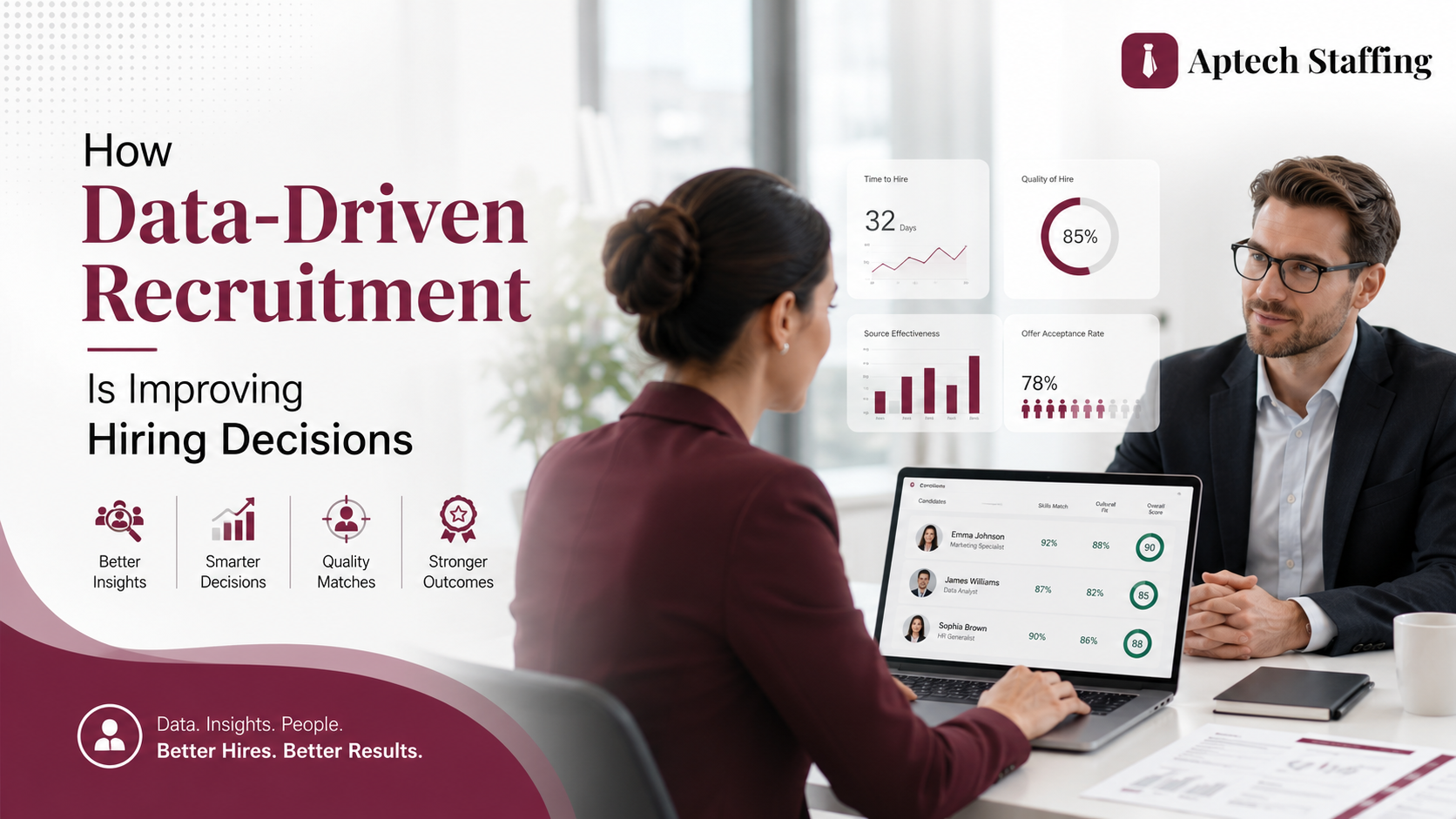
- Analyze time-to-fill, cost-per-hire and offer-acceptance to identify and address areas of delay before they become costly issues.
There isn’t a need for any drastic change in technology. Just consistently tracking the outcomes and reviewing them quarterly can be a good way for a mid-sized company to begin. The power is in the process of measuring, not in the precision of the instruments.
Predicting With Accuracy and Without Costly Mistakes
Aside from cost of employment, a bad hire costs money. Then there is the question of training and development, the impact that comes to light on team culture, and the few months that pass while there’s someone in the position, but no one qualified for it. Data-driven hiring can minimize these pitfalls and move the hiring process from “does this person look like the right person?” to “does this person reflect the results of those who have been successful in this position before?
Predictive analytics can identify candidate traits that are more likely to be predictive of retention over the long term for a given role. Perhaps candidates who only have two (or fewer jobs in the last 5 years) will remain longer within a client’s warehouse position. Perhaps, some of those assessment scores correlate well with the sales results six months later. Perhaps, some of those assessment scores line up very closely with the sales results six months in. These patterns are not apparent on a single look at a resume, but can be discerned after a period of monitoring the right statistics.
That’s where staffing agencies like Aptech Staffing, best staffing agency in USA make a difference. We see trends in dozens of roles and industries simultaneously– more than one in-house HR team, working only on a couple of roles per year, would ever have the data to identify that trend.
Shaping Up the Media Representation of Race and Ethnicity Issues
One of the more meaningful of data-driven hiring is that it can ease unconscious bias. If all candidates are assessed under the same criteria (rubric), the results are less susceptible to such subtle effects as geographic origin or a personal background that is similar or dissimilar to the interviewer’s. Blind resume screening, standardized skills testing, and scored structured interviews take screening further toward what matters– can this person do the job well?
Just a moment here: Data is not necessarily free from politics. If previous hiring patterns are indicative of bias, algorithms that are based on such patterns can reproduce bias. Which is why data-driven recruitment, responsibly, is an ongoing process of auditing results by various candidate groups—and not assuming a system simply generates numbers. A good staffing partner doesn’t see this as a one-off “set up” task, but as an ongoing commitment.
This will be a fast turnaround without compromising on quality.
Sometimes, the challenge for recruiters is to fill a job quickly, but accurately. Fortunately, data-driven strategies alleviate that tension. If you’re aware of which sourcing channels, screening questions, and assessment steps are effective for getting to successful hires then you can reduce the process of steps that are not adding value to your hiring process and rush ahead in the steps that are. That’s why working with data is a large reason why staffing processes tend to be faster without compromising quality.
Candidates’ experience is also enhanced. No one wants a hiring process that feels like a black box, and extends over weeks with no definite end in sight. If recruitment is based on clear data checkpoints, communication is more consistent and candidates receive the true answer quicker.
The Human Element Still Matters
This does not make recruiters an optional. Numbers won’t always show you whether a candidate will play along with a successful applicant, though, and they won’t necessarily identify attributes such as how he or she might be able to cope when hit with a sudden disagreement with a colleague, or whether the candidate will be able to really fit in with a team’s culture. The best hiring processes are ones that leverage data to screen candidates but don’t eliminate these questions, instead allowing recruiters to have a better conversation.
How Aptech Staffing Applies This
We, at Aptech Staffing, best staffing agency in USA, have integrated all the information from the industry with a detailed study of the particular client’s background in hiring. The key is to see what has worked to fill a certain position at a certain company, not a prescribed formula. A feedback loop develops over time: each placement, good or bad, provides learning that chisels in future recommendations.
Data-driven recruitment isn’t about excluding people from the hiring decision. It’s ultimately a matter of ensuring that those making decisions are better informed. This means less expensive mis-matches, more equitable evaluations and easier hiring, that does not get harder the more that is used. The improvement that builds up over time, quarter-by-quarter, hire-by-hire is the kind of improvement that’s this.
Frequently Asked Questions (FAQs)
What is data-driven recruitment?
Data-driven recruitment is a hiring strategy that leverages measurable data, like the performance of your sourcing channels, structured interview scores, and the results of your hires in the past, to drive decisions rather than relying on intuition or a “gut feeling” about candidates. In Aptech Staffing, this approach is adopted for sourcing, screening, and onboarding to minimize the guesswork in hiring.
What are the benefits of data-driven recruitment?
It enhances the hiring practices by using evidence of previous outcomes instead of subjective judgment. Employers can capitalize on the proven relationship between the candidate’s traits, source and interview scores with predicting who will be successful or unsuccessful over time, and reduce the expense of a mismatched hire.
Can hiring be done without recruiters when it’s based on data?
No. Recruiters are not replaced by Data-driven hiring. While patterns can be identified and powerful matches highlighted through the data, there are other characteristics that data does not factor in — such as the “cultural fit” “communication style” or “team dynamics” — that gets assessed by a recruiter.
Does data-based hiring eliminate hiring bias?
Yes with the correct use. Conscious and unconscious bias are minimized through structured score cards and standardized assessments. Historic data, however, may be subject to ongoing bias if it is not regularly audited and can be used responsibly only with the necessary review.
What metrics does Aptech Staffing use to measure its hiring efforts and get better results?
Aptech Staffing monitors parameters like time to fill, cost per hire, offer acceptance rates, measures channel effectiveness and retention after placement. These metrics are analyzed across roles and industries for patterns that can enhance the future recommendations for hiring.
Does data-driven recruitment only apply to big businesses?
No, even small and medium-sized businesses can get advantages by monitoring the outcomes of hires on a regular basis. It is not the cost of technology alone but disciplined measurement over time that is the value here.
What are the differences between a staffing agency such as Aptech Staffing and an in-house HR team?
The multi-line and multi-industry approach of Aptech Staffing means it’s an expanded set of numbers of hiring outcomes available compared to many one-line companies. This larger dataset will also help provide pattern-of-success which an in-house team that hires just a handful of people per year may not have sufficient information to see.
Does hiring data actually shorten the process of hiring?
Yes. By learning what portion of their sourcing activities and screening processes predict successful hires, recruiters can reduce low-value strategies and leverage their resources and time on the strategies that yield results, thereby reducing time-to-hire without compromising the quality of hires.
Does data-driven recruitment really work for measuring employee retention?
Can be used effectively to enhance retention predictions by uncovering attributes and experiences associated with higher retention rates within specific roles. While it is not fool-proof, it does help to close the gap between making a guess and taking a well-informed decision on whom to hire.