A friend of mine spent three months applying to tech jobs at the start of this year. Strong background, good portfolio, the kind of resume that used to get callbacks. He heard back from maybe one in ten companies. When we talked through what was happening, the issue wasn’t that the jobs weren’t there. It was that the market had quietly rewritten its expectations and nobody sent out the memo.
That’s the thing about 2026. There’s still a lot of hiring happening in tech across the United States. But the game has changed enough that candidates who were thriving three years ago are now getting passed over, while others with more focused, updated skill sets are fielding multiple offers.
At Aptech Staffing, best staffing agency in USA, we work with companies across industries every day. We see both sides of this equation. And this is our honest read of where things stand right now.
The Market Reset That Most People Didn’t Notice
Between 2020 and 2022, tech companies hired aggressively. Teams grew fast, sometimes too fast. When economic pressure came, the layoffs that followed weren’t just cost-cutting — they were a recalibration. Companies used that moment to figure out what they actually needed versus what they thought they needed during a bull market.
The result is a hiring environment that’s more deliberate and, frankly, more demanding. Open roles exist because there’s a real business problem behind them. A cloud migration that stalled. A data pipeline nobody can make sense of. A security posture that kept the CISO up at night. Employers are not filling seats. They’re solving specific problems, and they want people who can walk in and own one.
Generic applications to generic job listings are not cutting it anymore. The candidates getting hired are the ones who can connect their skills directly to a company’s actual situation.
AI Roles Are Growing, But Maybe Not the Ones You’re Thinking Of
When people hear that AI skills are in demand, they picture research labs and teams building large language models from scratch. That’s a small slice of the market. The much bigger and frankly more accessible opportunity is in applied AI.
Most companies are not building their own AI. They’re trying to figure out how to use the tools that already exist — how to integrate them into products, make them reliable, and measure whether they’re actually working. That’s where the hiring is concentrated right now.
Skills that are getting serious attention from hiring managers:
- Prompt engineering and LLM integration — OpenAI, Anthropic, and open-source alternatives
- Python ML ecosystem: PyTorch, scikit-learn, Hugging Face
- MLOps: building systems to monitor, retrain, and deploy models reliably
- RAG architecture — particularly for enterprise knowledge management applications
If you’ve been avoiding AI because it felt too specialized, it’s worth revisiting that assumption. You don’t need to train a model to be valuable in this space. You just need to understand how to work with them practically.
Cloud Engineering: The Complexity Has Multiplied
Cloud is not a new topic, but what companies are asking of cloud engineers has shifted considerably. A few years ago, being solid on one platform was enough. These days, most mid-to-large organizations are running across two or three platforms simultaneously, and they need people who can operate in that environment without causing chaos.
Cost management has also become a serious priority. It’s not enough to know how to build on AWS or Azure — employers want engineers who understand the financial implications of architectural decisions. That combination of technical and commercial awareness is genuinely rare.
What cloud roles are requiring in 2026:
- Azure certifications: AZ-104, AZ-305, and the Solutions Architect track
- AWS: Solutions Architect and DevOps Engineer paths carry the most weight
- Kubernetes and container orchestration: close to a baseline expectation now
- Terraform or Pulumi for infrastructure as code
- FinOps fluency: understanding and managing cloud spend proactively
Cloud engineers who can have an intelligent conversation about cost optimization with a finance team are getting strong offers. That’s a narrow group, and companies know it.
Cybersecurity Hiring Has Become Genuinely Urgent
The talent gap in cybersecurity has been talked about for years. In 2026, it’s stopped feeling like a background issue and started feeling like a crisis for a lot of organizations. AI-assisted attacks are more sophisticated. Ransomware is still everywhere. And the number of qualified people to handle it hasn’t grown fast enough to match the need.
Cloud security and identity management are where we’re seeing the most urgent hiring activity right now. That tracks with where the breaches keep happening — misconfigured cloud environments and compromised credentials account for a substantial chunk of incidents.
Roles and skills in active demand:
- Cloud security specialization: AWS and Azure security tracks, CCSP certification
- SOC analyst experience: especially with Splunk or Microsoft Sentinel
- Zero-trust architecture and IAM design
- Incident response and digital forensics
- Penetration testing: OSCP is still the benchmark certification here
One thing worth saying to anyone considering a career change: cybersecurity is one of the more realistic fields to break into without a traditional degree. Good certifications and documented lab experience — through platforms like TryHackMe or Hack The Box — can open doors that surprised a lot of people. The hiring managers we work with increasingly care more about demonstrated skill than academic pedigree.
Data Analytics: The Gap Is Not Technical, It’s Communicative
One complaint we hear constantly from companies trying to hire data professionals: there’s no shortage of people who can run queries and build dashboards. What’s genuinely scarce is analysts who can translate what the data is saying into something a leadership team can act on.
That communication layer — turning a chart into a recommendation, or a trend into a decision — is where most candidates fall short. It’s also where the best-paid analysts earn their money.
Technical foundations still needed:
- SQL at an advanced level: window functions, query optimization, data modeling
- Power BI and Tableau for dashboarding and visualization
- Python for data work: Pandas and NumPy remain standard
- SAS is still widely used in pharma, healthcare, and financial services
- dbt for data transformation within modern analytics stacks
If you have the technical side covered, the single best investment you can make right now is in how you communicate findings. Structured thinking, clear writing, and the ability to frame data in business terms will set you apart from most of your competition.
Software Development: What’s Staying, What’s Growing
Java is still very much in the picture. That sometimes catches people off guard, but enterprise environments — banking, insurance, government, healthcare — are running on Java Spring Boot, and that’s not changing in the near term. The engineers who know it well are not struggling to find work.
On the front end, React has held its ground and Next.js has matured into a serious production framework. TypeScript has moved from being a nice-to-have to the default expectation on any team that cares about maintainability.
What employers are prioritizing right now:
- Java Spring Boot: microservices architecture in particular
- React and Next.js on the frontend
- TypeScript over plain JavaScript in most team environments
- API design: REST remains the standard, GraphQL increasingly relevant
- CI/CD pipeline familiarity: GitHub Actions, Jenkins, ArgoCD
- Basic containerization knowledge: Docker and Kubernetes fundamentals
The developer who codes in isolation and hands off to someone else to deploy is becoming less competitive. Employers want engineers who understand what happens after the pull request merges and take some ownership of the full lifecycle.
Quality Engineering Is Not What It Used to Be
The old version of QA — someone working through a manual test script, checking boxes — still exists in corners of the industry. But the roles companies are actively trying to fill in 2026 look quite different. Quality engineering is now a discipline in its own right, and fast-moving product teams depend on it.
Test automation is the baseline now. The candidates who stand out are the ones who can design a testing strategy from scratch, embed quality gates throughout a CI/CD pipeline, and think seriously about performance before production surfaces the problems.
- Selenium, Cypress, or Playwright: depth in at least one of these is expected
- API testing with Postman or REST-Assured
- Performance and load testing: JMeter, k6, Gatling
- Shift-left thinking: building quality in from the design phase, not checking at the end
- ISTQB certification still holds real weight in enterprise environments
The Quality Nobody Posts About in a Job Listing
Ask almost any hiring manager what separates the candidates they remember from the ones they forget, and they’ll eventually say something like: “I just needed someone who could communicate clearly.”
It sounds obvious until you’re on the other side of it. Written communication — the ability to explain a technical problem to someone without that background, to document your work so others can follow it, to ask a clarifying question instead of guessing — is rarer than it should be. In distributed teams, which is most teams now, it matters more than almost any specific technical skill.
Alongside that: genuine adaptability. Not the kind you write on a resume. The kind where priorities shift on a Tuesday and you adjust without needing two weeks of handholding. The tech market in 2026 is not a stable environment, and the professionals who are doing well in it have made peace with that.
Where the Hiring Is Concentrated Right Now
Not all industries are moving at the same speed. Based on what we’re seeing across our client base at Aptech Staffing, these are the sectors with the most active tech recruiting:
- Healthcare and Pharma: EHR systems, clinical data work, regulatory compliance technology, AI-assisted diagnostics
- Financial Services: risk modeling, fraud detection, compliance automation, legacy banking modernization
- Supply Chain and Logistics: IoT data integration, predictive demand tools, warehouse and fulfillment automation
- Consumer Products and Retail: e-commerce infrastructure, customer data platforms, personalization systems
Each sector has its own flavor of what it needs. But the common thread is that digital transformation projects that started several years ago are still mid-journey, and they need skilled people to carry them forward.
Where to Focus Your Energy From Here
If there’s one practical takeaway from all of this, it’s that depth wins in this market. Trying to be average at ten things is a much weaker position than being genuinely strong in two or three areas. Pick the domains where you have real interest and build from there.
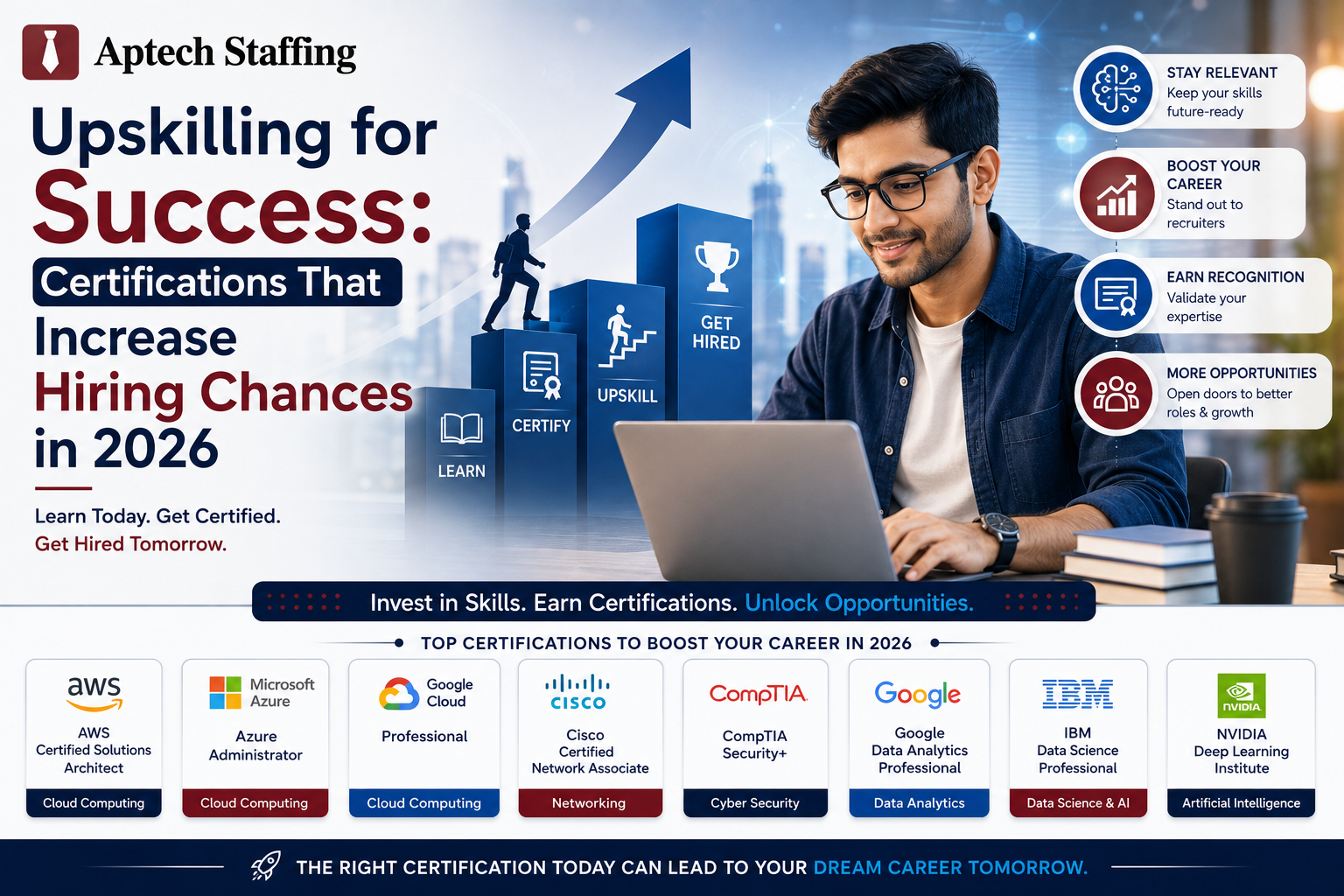
Certifications matter — not as a shortcut, but as a signal to employers that you’ve committed to a skill area seriously. Build things you can show. Have a project or two that demonstrates how you actually approach problems, not just a list of tools you’ve touched.
And if you’re trying to figure out where your current skill set fits in today’s hiring landscape — or which gaps are worth closing first — that’s a conversation our team has with candidates every day. At Aptech Staffing, best staffing agency in USA, we work directly with employers across all of the industries and roles covered here, and we have a clear picture of what’s actually getting people hired right now.