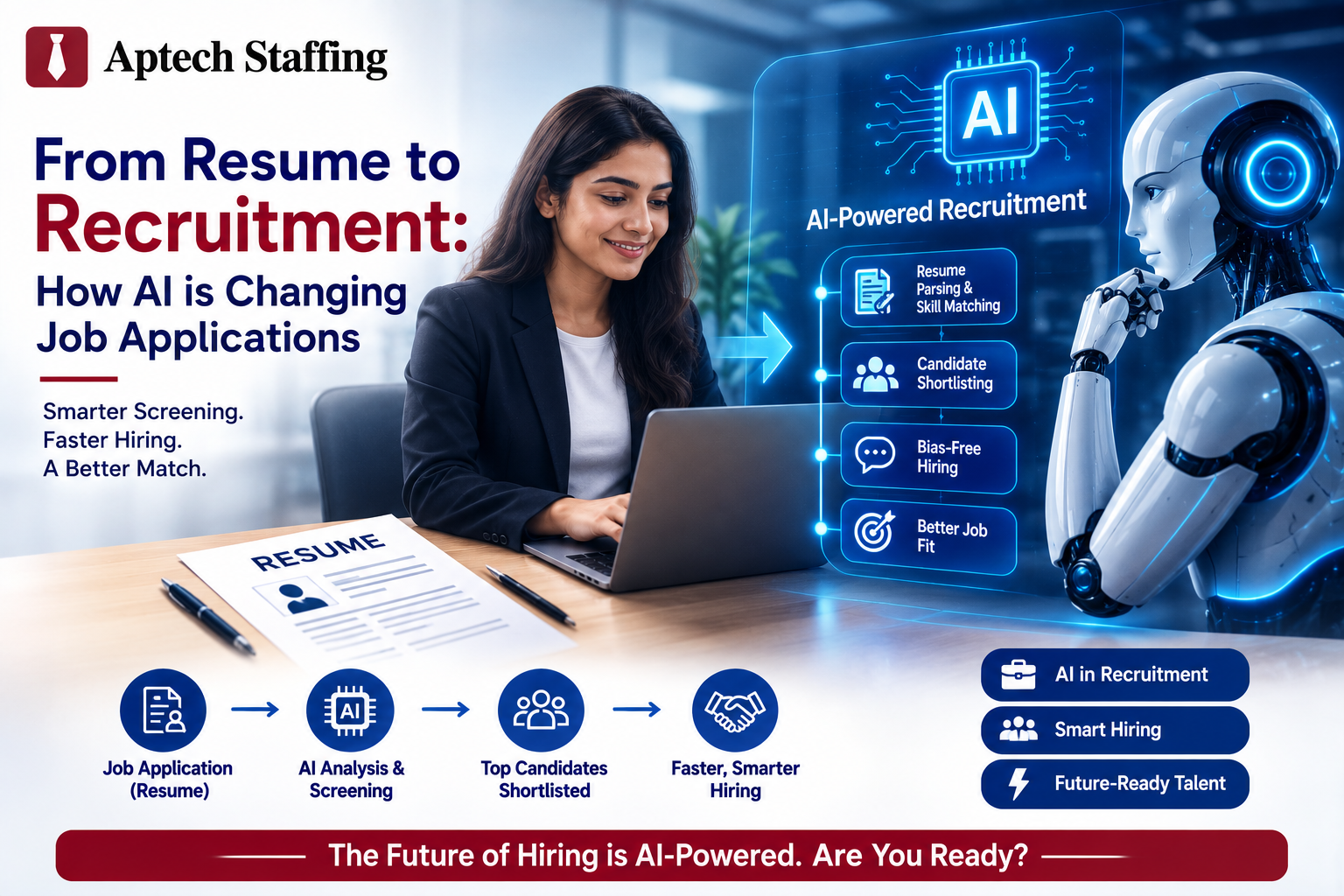
It’s a Tuesday afternoon, and Sarah, a senior talent acquisition manager, isn’t drowning in a sea of PDFs. Instead of manually scanning hundreds of identical-looking resumes, an intelligent system has already presented her with a curated list of ten candidates. But the algorithm didn’t just scan for “Java” and “5 years of experience.” It cross-referenced passive activity on niche developer forums, identified a pattern of micro-certifications that signaled a growth mindset, and flagged a candidate whose soft skills profile perfectly mirrored the communication style of the hiring manager’s existing team.
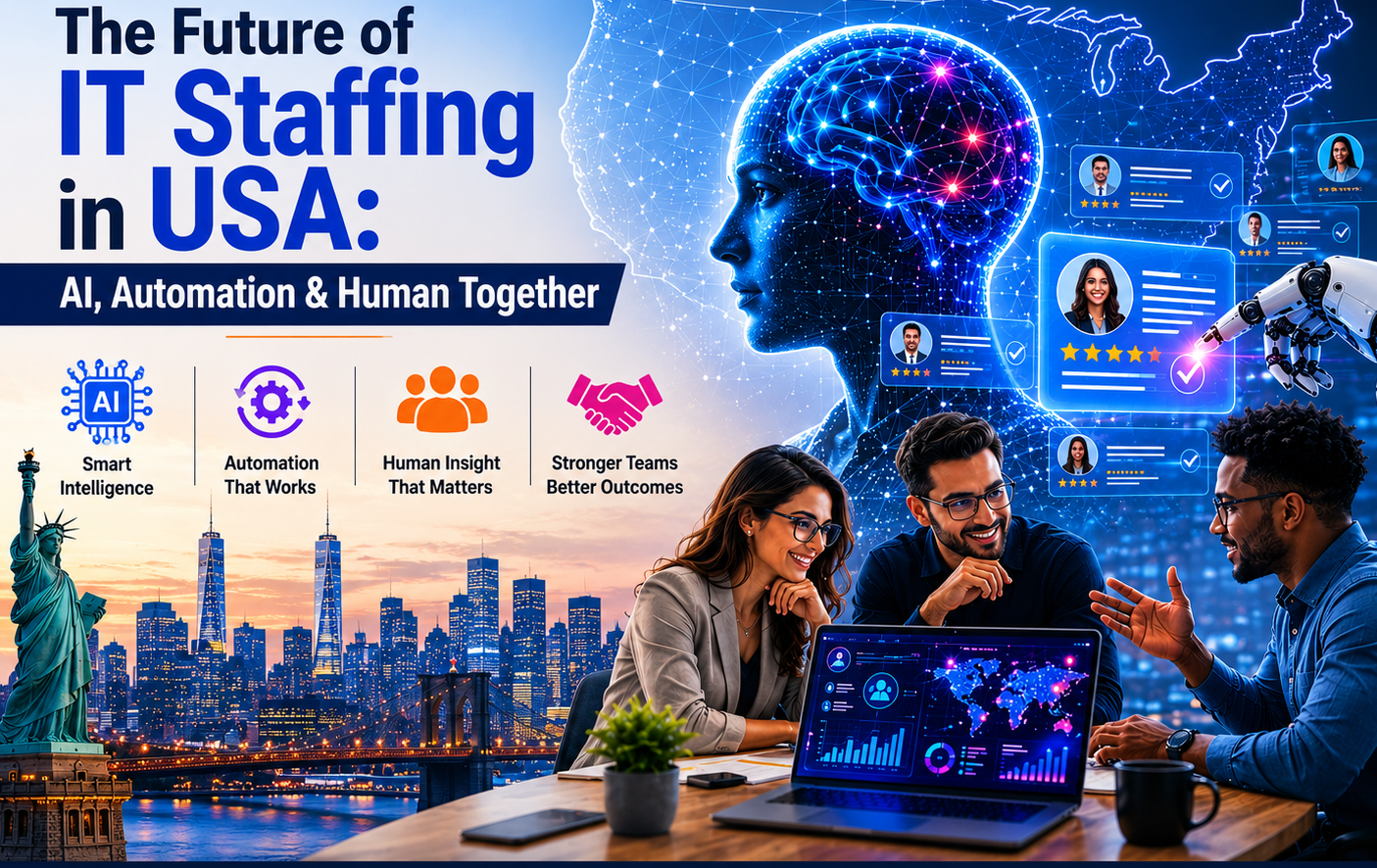
Sarah’s job isn’t gone. It’s just elevated. This isn’t a scene from a distant sci-fi novel; this is the immediate future of IT staffing in the USA, unfolding right now. At Aptech Staffing, best staffing agency in USA, we don’t just see this horizon—we are building the bridge to it. The future isn’t about robots replacing recruiters. It’s about a trinity: AI, Automation, and the irreplaceable Human touch working in concert.
The Death of the Rolodex and the Birth of Predictive Intelligence
For decades, the staffing industry relied on what we affectionately call the “spray and pray” method. Keyword matching was the king. If a job description said “Python” and a resume said “Python,” a match was made—even if the candidate’s actual passion was herpetology, not scripting. That era is dead.
The first wave of change is hyper-intelligent automation. In the USA, where speed-to-market determines competitive edge, a manual hiring process is a liability. Automation now handles the heavy lifting that used to consume 70% of a recruiter’s day. We are talking about automated compliance checks that instantly navigate the labyrinth of multi-state tax laws and visa regulations, and onboarding workflows that trigger the moment an offer is accepted, not two days later.
But the real game-changer is AI’s move from descriptive analytics (what happened) to predictive intelligence (what will happen). Modern systems don’t just find you a DevOps engineer; they predict the probability of that engineer accepting an offer based on market sentiment analysis. They can forecast if a project is likely to stall due to a predicted skill shortage in a specific micro-market, like cloud security architects in Austin. It’s no longer about filling a seat; it’s about predicting the needs of the enterprise before the ticket is even raised. This allows IT leaders to shift from reactive firefighting to proactive workforce planning.
Coding the Bias Away? The Rise of Skill-Based Verification
One of the most tired, yet persistent, flaws in human-led hiring is the unconscious bias that seeps into resume screening. The “pedigree filter”—looking only at candidates from a specific list of Fortune 500 companies or Ivy League schools—has caused American tech companies to miss out on millions of brilliant, non-traditional minds.
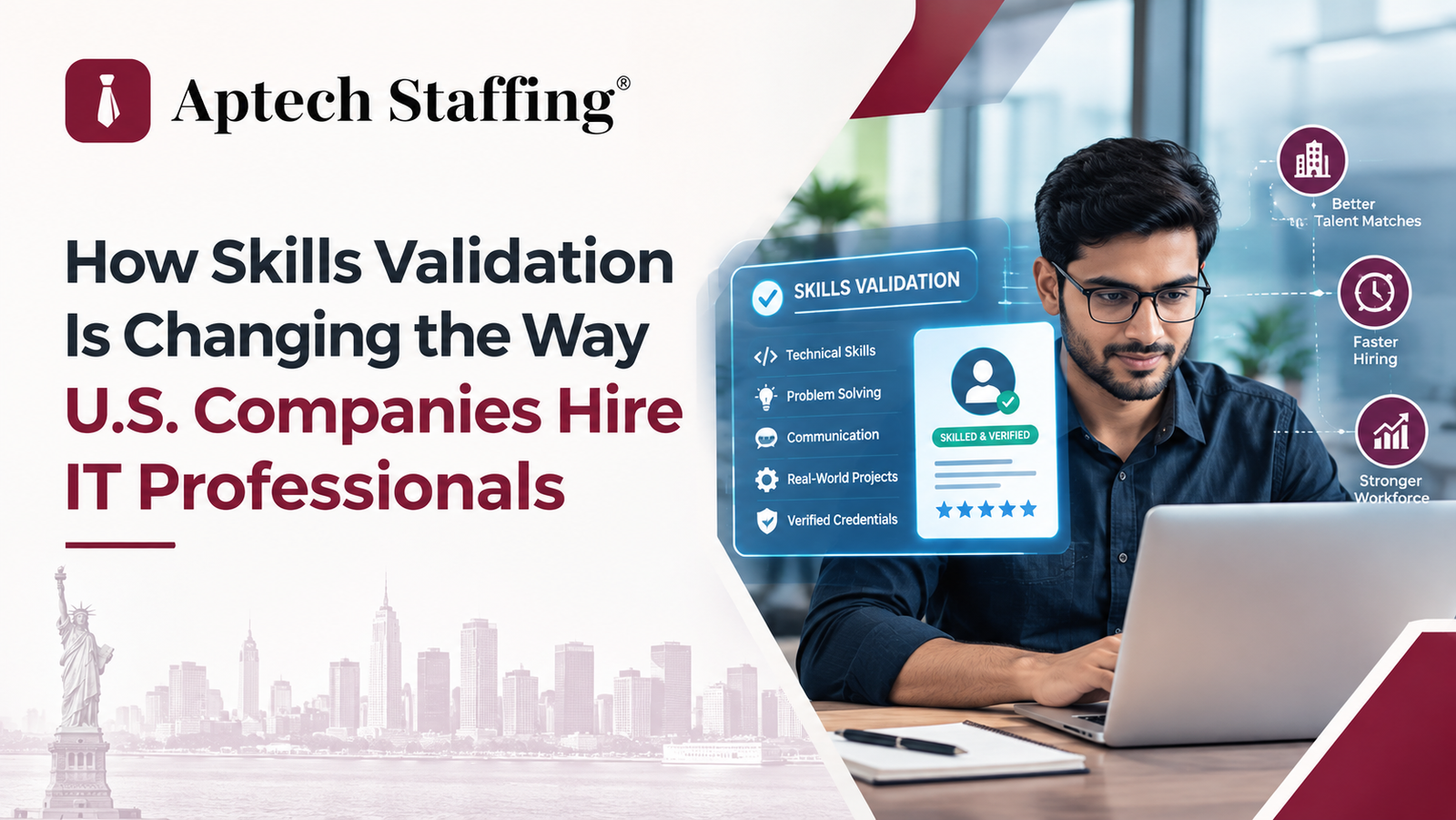
AI, when ethically trained and fiercely monitored, offers a scalpel where we once used a sledgehammer. The future we are building at Aptech Staffing, best staffing agency focuses on dynamic skill taxonomy. Forget the resume as a historical document; it’s often a lagging indicator. We are moving toward live skill verification. An AI can analyze a candidate’s public GitHub repository activity to assess code cleanliness and collaboration style, or evaluate their problem-solving logic in simulated, gamified environments.
This levels the playing field. It filters candidates in based on verified competency, not out based on a missing keyword. For U.S. companies struggling with the tech talent shortage, this is the unlock. It expands the total addressable talent pool exponentially, catching the self-taught AI specialist from a small town in Iowa who never had a FAANG company on their CV but possesses raw, undeniable computational genius.
The Unscalable Human Layer: Empathy as the Ultimate Edge
If AI and automation are so powerful, where does that leave the human? In a paradox, the more advanced our technology becomes, the more valuable the core human traits become. AI cannot, and should not, replicate consciousness. It cannot feel the subtle hesitation in a candidate’s voice when discussing a specific work culture, nor can it sense the spark of fierce loyalty a candidate has for their team.
The future of IT staffing in the USA is a partnership where machines handle the quantitative and humans champion the qualitative.
First, there is the matter of the “hidden decision.” Algorithms can be black boxes. The human recruiter’s future role is that of an interpreter, explaining to a hiring manager why a non-obvious candidate was surfaced—perhaps a career pivot that brings a unique cognitive diversity to a team stuck in groupthink.
Second, there is the architecture of trust. The American IT market is currently wrestling with a paradox: hybrid work is the norm, but cultural cohesion is the demand. A bot can’t negotiate the delicate dance of a counteroffer, where a candidate is torn between a 20% salary hike and a toxic boss who they still feel loyal to. A bot can’t mentor a recent graduate on how to frame a bootcamp project as equivalent enterprise experience.
At Aptech Staffing, best staffing agency in USA, we call this “empathic translation.” We use AI data points to start the conversation, but we rely on human intuition to close the deal. We understand that a candidate who took a six-month sabbatical to care for a parent isn’t a “gap in employment”; they are a person who demonstrated extreme resilience and time management. Only a human can read that story correctly and sell it to a client as a strength, not a weakness.
The Offense-Defense Strategy for U.S. Tech Firms
Looking strictly at the economics of the U.S. landscape, treating AI in staffing as merely a cost-cutting tool is a defensive, losing strategy. The winning strategy is offensive. It’s using AI to unlock human potential.
Right now, burnout among software engineers is at an all-time high. If you use AI tools to simply monitor productivity, you become a surveillance state that drives talent away. However, if you use AI to detect burnout patterns—like late-night commit patterns followed by silent periods—a human well-being coach can intervene with a conversation about workload, not discipline. That’s how you retain scarce talent.
Furthermore, the concept of “cultural fit” is being rightfully demolished and replaced with “cultural contribution.” In the future, AI will help us map not just if a candidate fits a static culture, but what new element they add. Does this team need a contrarian? A harmonizer? A finisher? Humans define the culture; AI helps de-risk the chemistry.
The Irreducible Core of Judgment
The staffing industry is ultimately about life-altering decisions. A job change changes a person’s geography, their income, their mental health, and their family’s trajectory. Reducing that transaction to a purely algorithmic, frictionless assembly line is a dystopia we must actively resist.
The future we champion at Aptech Staffing, best staffing agency in USA is one of “augmented intimacy.” It’s using the cold efficiency of data-crunching to give us the time to be warmer. By letting automation handle the administrative drudgery and letting AI illuminate the patterns we cannot see, we buy back the most precious resource in the industry: time to listen.
When a cleared defense contractor is weighing whether to leave the D.C. beltway for a private AI startup, they aren’t making a spreadsheet decision. They are making a life decision. They need a human partner who understands the market data (thanks to AI) but who also understands the fear of leaving a security clearance behind (thanks to human experience).
The U.S. tech sector doesn’t just need more bodies. It needs more cohesion, more innovation, and more foresight. That can only come from a staffing model where technology empowers, rather than erases, the human spirit.
The future is here. It’s automated, it’s intelligent, but above all, it’s deeply human. And at Aptech Staffing, we wouldn’t have it any other way. Let’s build the teams of tomorrow, together—with the perfect balance of circuit and soul.