Smart manufacturing is transforming the way U.S. factories are run. Manufacturers are benefiting from connected machines, sensors, robotics and artificial intelligence (AI) for better productivity, quality and decisions. However, technology can’t provide these results.
There is also a need for companies to hire people who are able to operate, maintain, secure and enhance digital manufacturing systems. For this reason, the staffing for smart manufacturing in USA is on top of the employers’ priority list when moving towards Industry 4.0.
The Impact of Industry 4.0 on Hiring
Industry 4.0 brings enterprise software and data platforms together with equipment at the plant level. It enables manufacturers to use live information as well as information from the past.
This change brings a need for staff familiar with the workings of the body and the digital systems. Technician may be required to troubleshoot automatic equipment. There may be instances where an engineer is required to interface sensors with a data platform. Production analytics can require an interpretation from a quality professional for a quality outcome.
Smart manufacturing cannot take the place or anti-thesis of human. It moves the prerequisite skills people must master to be successful.
The National Institute of Standards and Technology (NIST) defines 132 occupations related to 235 knowledge, skills and abilities required to meet the needs of advanced manufacturing technologies by 2030. This reflects the wide range of the talent need.
Arrange the key roles in Smart Factory
Smart manufacturing workforce is not just limited to machine operators. There is a need for a combination of production, engineering, technology and quality talent in the employer.
| Role | Primary responsibility | Skills to prioritize |
|---|---|---|
| Automation technician | Maintains and troubleshoots automated systems | PLCs, robotics, electrical systems |
| Industrial engineer | Improves production flow and efficiency | Lean manufacturing, data analysis |
| Controls engineer | Designs and supports automation systems | PLC programming, HMI, SCADA |
| Manufacturing data analyst | Turns production data into insights | SQL, analytics, visualization |
| Industrial IoT specialist | Connects machines and sensors | IoT protocols, networking, cloud platforms |
| Cybersecurity specialist | Protects operational technology | OT security, network security, risk management |
| Maintenance technician | Keeps equipment running reliably | Mechatronics, preventive maintenance, diagnostics |
Many times the best candidates are those who have knowledge of both Plant floor and Enterprise systems. A knowledge of ERP, MES, industrial IoT and cloud data engineering and operational technology security skills is typically in demand for industry 4.0 programs as well as controls and automation skills.
Skills Employers Should Prioritize
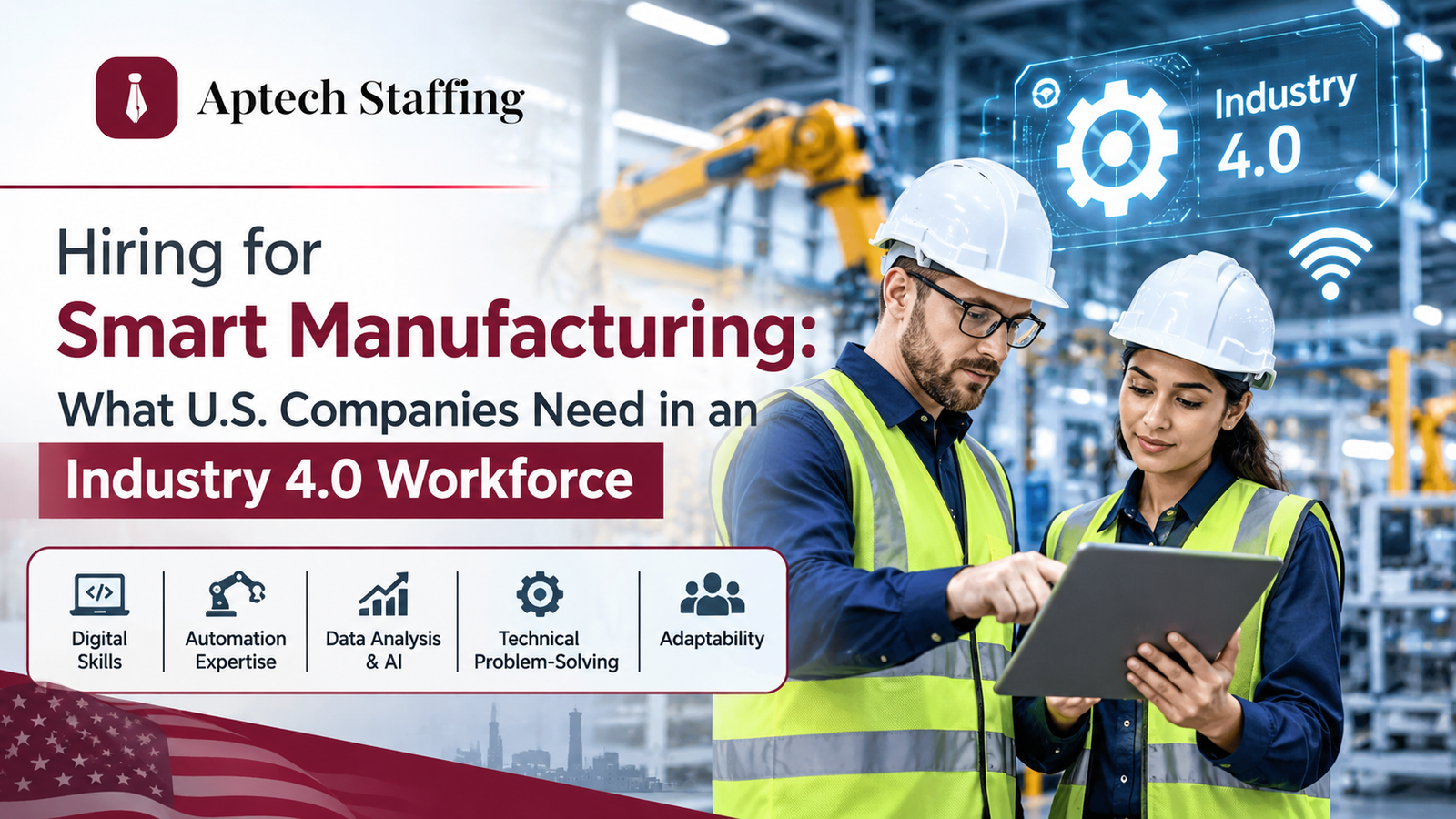
Smart manufacturing is as much as it is about technical ability, its adaptability. It requires employees to be receptive to new systems and thinking, to interpret information across various departments and entities.
Employers should look for:
- Knowledge on PLC and automation.
- Skills in operating and maintaining robots.
- Ability to analyze and solve problems.
- Knowledge of MES and ERP systems and IoT systems within the industrial process.
- Cybersecurity awareness.
- Prevention, troubleshooting skills.
- Effective communication and working collaboratively.
- Interested in new technologies.
NIST recognizes that emerging AI capabilities will require workers to have a variety of skills- everything from operating robots or robots capable of collecting and interpreting data, to understanding and managing a smart system.
Create a Workforce Plan
Employers should not start hiring when a project comes on scaffolds! A workforce plan should help pinpoint the skills currently lacking in the workforce and the roles required, along with investments in technology that will be necessary in the future.
Start by reviewing:
- Current capabilities of automation and robotics.
- The use of digital systems throughout production and quality.
- Wear and tear of machinery and upkeep.
- Risks associated with the use of cyber technology in operational technology.
- Projects in progress (ERP, MES or IoT)
- Risk of retirement among highly experienced techs.
- Workers’ current training requirements.
This review informs employers if they are to take on permanent staff, be in contract to find a professional, form a project-based team or undertake an upskilling program.
Implement Flexible Hiring Strategies
Not all of a company’s smart manufacturing requirements necessitate a permanent employee. There are roles that are specific to a project whose duration may be limited and then there are roles that are specific to a project from the onset that needs to be owned or retained for a longer time.
| Hiring model | Best suited for | Main benefit |
|---|---|---|
| Permanent hire | Core engineering and maintenance roles | Builds long-term capability |
| Contract professional | Automation upgrades and digital projects | Adds specialized expertise quickly |
| Temp-to-hire | Uncertain long-term needs | Allows performance assessment first |
| Project team | ERP, MES or IoT implementation | Supports complex initiatives |
| Upskilling | Existing employees with strong potential | Retains knowledge and reduces hiring risk |
According to Hays, three out of four humans companies feel skill deficits are the foremost obstacle to organizational change (63%), 42% anticipate that talent will be absent from their organizations over the next 5 years. Employers can use flexible hiring to flexibly adjust to changes without putting their modernization plans on hold.
Invest in and Develop Internal Talent
When hiring outside of the organization, it’s crucial but don’t forget about the talent already in-house. Often, production processes are known to better than anyone the experienced machine operator, maintenance worker and quality professionals.
An Internal Capability building can be achieved through employers providing:
- Education on automation and robotics.
- Data literacy & analytics education.
- Cybersecurity awareness programs.
- Team building across production, technology.
- Earn & Learn or Apprenticeship.
- Define career pathways to technical career options.
As employers seek to balance skill-matched employees with learning agility, upskilling, mobility for employees to move internally and earn-and-learn are becoming more common- as per Hays.
Enhance Candidate’s Experience
You may find that good manufacturing prospects give applicants multiple job offers. Employers should be quick but at the same time give a professional experience when hiring.
A good process should contain:
- Job description with clear system and skills.
- Quick to respond following applications and interviews.
- Technical Assessments.
- Transparent compensation information.
- Improved understanding of training or growth opportunities.
- Smooth induction process.
They are going to be more welcoming if they know what they’re offered and know the technology environment and the company’s investment in their development.
Connect with a Staffing Partner
The right staffing partner will be able to connect employers with candidates who not only have technological expertise, but can comprehend how this technology can be applied to manufacturing. Aptech Staffing is a bridge between skilled professionals in the field of technology, finance and healthcare & manufacturing.
Some criteria employers should use when considering partners for industrial automation recruitment are concerning previous experiences with automation or robotics or ERP or MES or industrial IoT placements. One other thing about it is that a partner should be aware of is the difference between IT and operational technology environments.
While choosing manufacturing technician staffing partners, employers should seek out someone who can evaluate practical skills, awareness and safety and proficiency in a busy production environment. Hiring Industry 4.0 talent goes beyond just job titles; it involves comprehending the interconnections of skills between systems.
Final Thoughts
Smart manufacturing can provide significant opportunities for U.S. businesses to increase their efficiency, quality and competitiveness. However, it is basically the right work force that makes the difference to success.
Employers need to clearly identify the skills required, identify their own talent, adopt a flexible approach to hiring and ensure ongoing development. The proper smart manufacturing staffing in USA decisions can develop groups to fulfill the needs of Industry 4.0.
Frequently Asked Questions (FAQs)
What is smart manufacturing?
Smart manufacturing has connected machines, sensors, robotics, data analytics and automation to enable enhancing the efficiency and quality of production, along with decision making. It is an integral component of ‘Industry 4.0’.
What will be the requirements of U.S. manufacturers in Industry 4.0?
Automation technicians, controls engineers, industrial engineers, robotics specialists, maintenance technicians, industrial IoT specialists and data analysts and cybersecurity experts are among a wide array of skills and knowledge that manufacturers are seeking in employees.
What are the key skills required for smart manufacturing?
Plc programming, robotics, industrial automation, data analysis, preventive maintenance, industrial IoT, MES and ERP systems, cybersecurity awareness are the key skills that are important. It is also beneficial to have a good pair of problem solving and good communication skills.
Will smart manufacturing be a replacement for manufacturing workers?
No. Smart manufacturing can transform multiple jobs across various value domains instead of eliminating jobs. Digital skills, data literacy and working with automated systems is becoming increasingly important among workers.
When is it appropriate for a manufacturer to hire temporary staff?
Temporary workers assist with equipment maintenance, tooling or machine assessments, ERP or MES implementation, season peak production boost or equipment replacement and evaluate equipment during installation or assess for short term skill shortages. They help you with specialty support but don’t require a long-term hiring agreement.
How can Aptech Staffing help with smart manufacturing recruitment?
Aptech Staffing is bridging the gap between employers in the U.S. who seek skilled workers in the technology, manufacturing, finance and healthcare sectors. The company can satisfy these manufacturing employees’ smart requirements via temporary work, contract work and permanent work options.