Were you in the midst of a “trial period” for remote work? The early pandemic days of awkward Zoom calls, pets barge-checking meetings, and makeshift home offices have grown to a higher art. Welcome to Remote Work 2.0 – the honeymoon phase is over and business as usual is here.
We’ve seen it happen at Aptech Staffing, best staffing agency in USA. It’s “Thank you for showing up” days are behind us. But today’s employers have taken a different level, and it’s critical to grasp their new expectations to succeed in the modern workplace.
This is how remote work has developed over time.
Let’s face it – Remote Work 1.0 was a matter of life and death. Businesses scrambled to ensure they were running and they moderated the quality of their work and communications in order to keep going. However, the initial stage has passed. Companies have built up investment in far-flung technology, their operational procedures and an understanding of what successful remote work means.
So it’s not the quest for a return to pre-pandemic routines or a complete transition to a digital-only environment. It’s about finding the sweet spot – hybrid models, flexible arrangements and working environments based on results instead of attendance.
What Employers REALLY want Now: Results Over Hours Logged
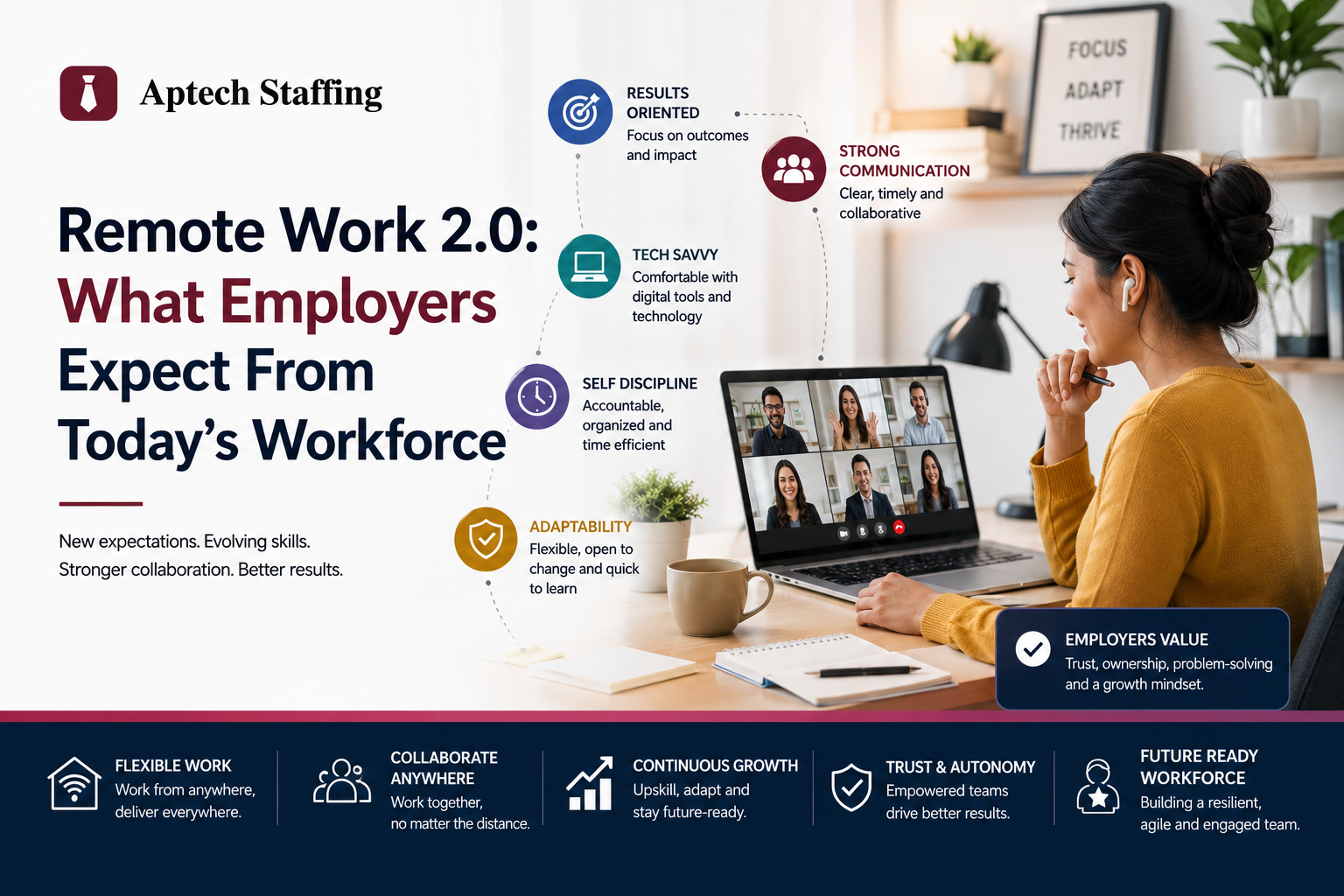
What we’ve seen most in terms of change is the focus on non-time tracking. Oh, no, it’s not whether you get up at 6 AM or 10 AM, but whether you do at all that matters to the employer. The only thing that’s important is whether projects are completed, goals are achieved and there is tangible value in your work.
That doesn’t necessarily mean that you are going to be thinking differently about your day from saying “I worked eight hours today“, but saying “I did X, Y and Z today“. There is a shift from activity-based to outcome-based measures by the employers we work with at Aptech.
1. Supercharged Communication Skills
You might use non-verbal cues like body language, hallway conversations and spontaneous interactions in a physical office to establish rapport and expectations. These casual communications have been eliminated with remote working so it is more important than ever to intentionally communicate.
Employers want you to be proactive in communicating with others. Flooding of inboxes is not the answer here—what’s actually important is knowing what information is important to your reader and communicating it effectively and succinctly. Good writing skills, clear verbal communication and the ability to communicate in different ways using the media is no longer a choice.
2. Autonomy with Accountability
On the one hand, employers expect you to be totally self-directed at your place of work, and, at the same time, you are held totally liable for your decisions. They’re counting on you to organise yourself, make decisions about what to do and how to do it, and find your own answers. Yet you have to take ownership of your success and your failures with this freedom.
The employees who do well are the ones who do not wait for a yes or no sign or instructions. They evaluate situations accurately, make decisions and articulate them clearly. This is a very valuable endeavor in this “remote” world.
4. Tech Proficiency Beyond Basic Zoom: Expert in using Zoom for advanced purposes
Proficiency with video-conferencing software is a must take these days. You should be familiar with platforms that allow you to collaborate, such as Slack, Microsoft Teams or Asana. Much in the same way, however, what more important is that they also know how to improve productivity with technology instead of to distract.
That can involve looking after digital wellbeing and establishing ‘when’ and ‘how’ to switch off, boundaries and using apps and technology to make you more efficient, not burned out. Adaptability to new tools and platforms is also a critical skill that tech savvy people are increasingly looking for.
5. Emotional Intelligence in Digital Spaces
The emotional part of being remotely based is one of the biggest things that is overlooked. It’s not easy to pick up on difficulties, frustration or offer help when not physically present. Employers are looking for an individual who can read between the lines in writing and be true to the caller, who can show empathy in a virtual meeting. Employers today are looking for someone who can “read between the lines” of written communication and be equally empathic in a virtual meeting.
This involves paying attention to how you use your voice when you email, being patient when things don’t work out with tech and proactively asking how the team member is doing. The remote working environment may be virtual, but the human component is more crucial than ever.
6. Consistent, Reliable Presence
Employers are not watching you every minute, but they know that you should be present and active when you’re needed to collaborate—when it matters at the most critical times of the day. This does not involve sitting at a desk all day long, but rather to be responsive to urgent communication within a reasonable time (usually not more than 24 hours) and attend scheduled meetings.
The words here are “reliable“. Employers want to know that they can rely on you for a deadline, a client meeting, backing a teammate who needs assistance, etc.
7. Adaptability and lifelong learning
Virtual off-the-job training is still a dynamic process, and the tools, processes, and expectations will continue to evolve. Employers are looking for team members that would like to continuously learn and adapt without being depended on. The standout employees are those who have taken initiative to learn, keep their eyes and ears open as to changes in the industry, and actively recommend solutions to the remote working process.
8. The Hybrid Reality
There are many firms that have come to a compromise between both kinds of work, and it has its requirements too. Being hybrid-ready means you can seamlessly transition between remote and in-person work. It’s all about learning how to actively engage remote team members in the office and how to make yourself visible when you’re working remotely.
Self-Management Is Non-Negotiable
One of the basic requirements with every employer is that you can effectively manage yourself. This includes the things from having a productive home workplace towards controlling energy levels, keeping social isolation to a minimum and keeping working-life separations.
An odd thing about working remotely is that it takes more work, not less. When you don’t have the structure of having an office, you need to establish boundaries, routines and motivations on your own, including motivation through tasks you would rather avoid.
What This Means for Job Seekers
When you are starting your career, or thinking about switching jobs, it’s crucial to know what is expected according to Aptech Staffing, best staffing agency in USA. Create your resume and interviews in a way that demonstrates technical abilities and also the capacity to operate autonomously, communicate well in a remote capacity and accomplish objectives without daily oversight.
Frequently Asked Questions (FAQs)
What is Remote Work 2.0?
The continued, grown-up form of telework is Remote Work 2.0. In the pandemic, businesses had to live with reduced productivity, no communication, and was under survival mode. In the present environment, there are many organizations that have enhanced their infrastructure and have been able to inculcate a certain level of expectations.
Can you tell whether a product is designed with excellence in mind?
Absolutely. This is one of the biggest changes that we’ve seen at Aptech Staffing. Employers are shifting their focus to determining what is produced instead of how long it takes. They are interested in what you achieved, rather than when you began work.
Will I have time for a bit of research?
The key to success isn’t making 9 to 5, it’s about deadlines, targets and quality work. This is best done through goal setting and consistent communication to ensure expectations are congruent.
How to communicate well from afar?
Effective remote communication is about being proactive, clear and flexible. Communicate important news or information but not too much. Select appropriate channel– email for formal updates, Slack for quick questions, video calls for detailed discussions. Improve written communication as most communication is in the text.
If I am not tech savvy, what can I do?
But basic tech skills have become a must-have. Comfort level with videoconferencing, collaborative tools, and project management applications is expected. On the other hand, don’t require a rocket scientist. It’s important to be open to learning new tools quickly, and adjusting your processes when technology advances.
How do I keep my work-life balance?
Create intentional structure. Establish definite working times and explain them. Designate a work area that is an actual place where you can physically go at the end of the day. Work on other devices and/or in other profiles. Make sure to take regular breaks and not check email after work.
Will working remotely be detrimental to my career advancement?
No, but, it will take a bit more purposeful effort. Being seen is not a right or automatic occurrence, you must do the work to be seen. Make sure to regularly let managers know about accomplishments, volunteer for important projects, solicit input from others and develop connections outside your group. Have virtual coffee chats and brainstorm successes!
What should be included in an employer’s remote work policy?
Search out clear and consistent policies, not vague expectations. Verify if they supply essential equipment, virtual wellness resources, and have communication standards. In interviews, inquire about their approach to measuring performance, supporting career development for their remote employees, and equating hybrid team members.
Will hybrid working remain?
It seems that hybrid is the predominant model in most knowledge industries. Whilst some businesses advocate for complete returns, the bulk acknowledge the worth of flexibility. Successful hybrid, however, does come with a caveat: Employers need to plan for it, and expect productivity on days off-the-grid to be the same as it is on days in the office.
What will I need to know to prepare as a newbie for Remote Work 2.0?
Develop self-control and ability to communicate. Develop work-related patterns. Learn to set and carry out deadlines. Discover workflow tools such as Slack, Zoom and project management software. Develop emotional intelligence: When working remotely, ability to navigate situations and respond empathetically in digital environments is a hallmark of exceptional remote workers.
If I am having trouble with my expectations in remote learning, what can I do?
Communicate early – don’t wait until problems escalate. Honesty and a desire to learn are desired by most employers. Look for specific feedback and make an action plan. Consider professional development or mentoring.