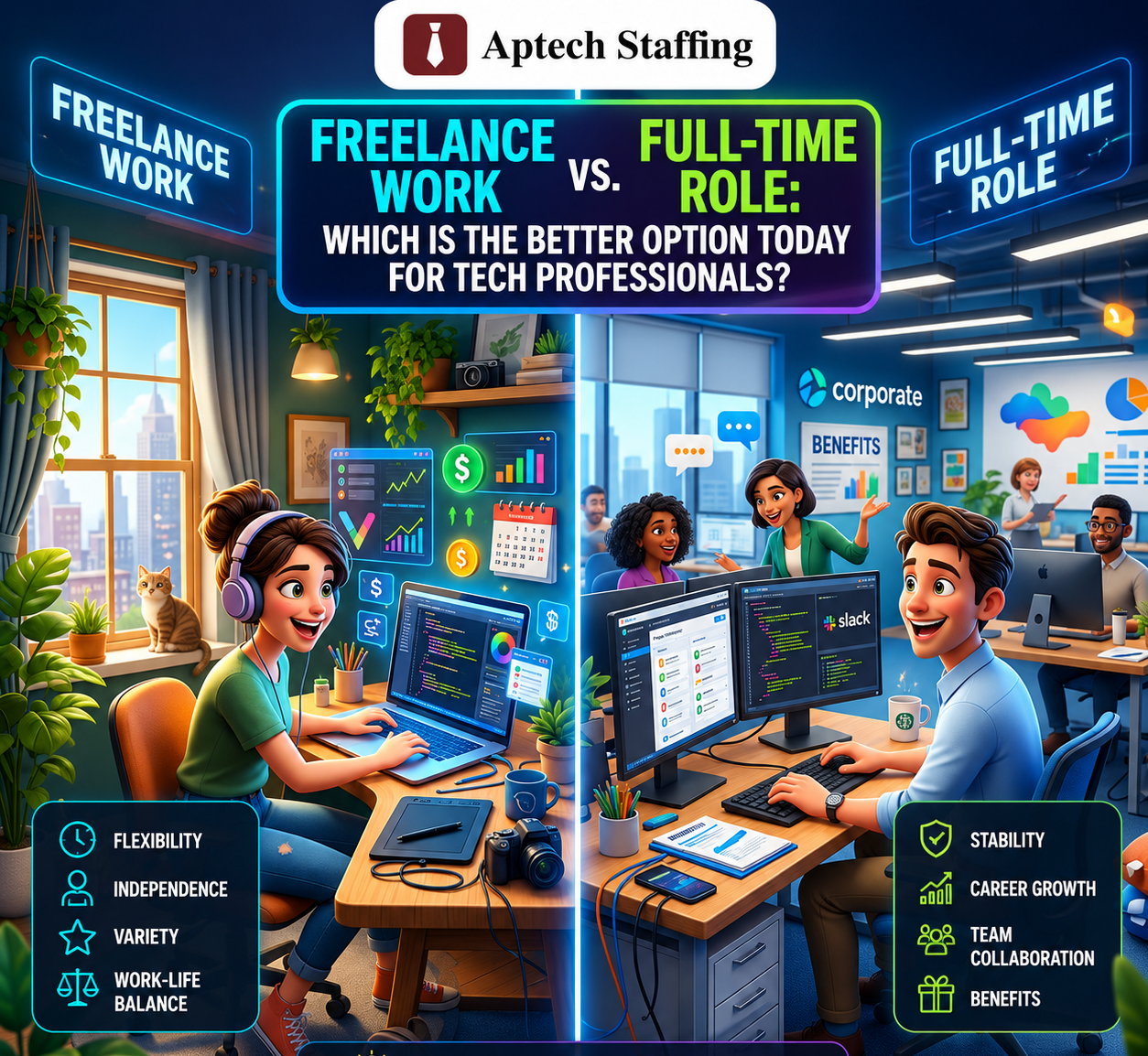
The modern tech professional is at a fork in his/her road and this is a road that previous generations never had to traverse. In one direction is the known world of working full-time; a reliable salary, a well-defined career and a group of people that is like a second family. The other way involves freelancing—the open sea where you are the captain of your ship, and you control a myriad of projects and possibilities. If you’ve read this, you probably haven’t gotten a good night’s sleep because you wanted to know, which one is better?
There’s no right answer, but there’s a right answer for YOU right now! Daily, at Aptech Staffing, best staffing agency in USA, we’re at the center of this discussion! We pair up incredible developers, designers and architects with contract positions and permanent opportunities, and so we have a bird’s-eye view of the tech sphere. Let’s cut down the noise and discuss the actual human dimension of trade-offs, as it’s not just about the paycheck.
The lure and fear of the Freelance Frontiers
People tend to perceive freelancing as a dream life. Investigators, you’ve seen the posts on Instagram: a developer is at a beach in Bali coding away, a UI designer is sitting with a latte at 12 pm on a Tuesday. The freedom is real, but it’s not what it seems. Freelancing itself is a decision on business as well as a career.
Freedom, the most addictive of all benefits. Your calendar is your own personal creation. In the case of a brain that tends to fire like a pro at 11 pm, make your day work from that time. The most important, you have a ceiling to your income. A 10th Percent in Salary positions is a wonderful year. The value of finishing a project under budget and on time is that as a freelancer, you are free to pursue the next cash-cow, giving yourself a huge monetary boost overnight. You work on a piece-by-piece basis, not for time sitting in front of a chair.
Then there is the different. A freelancer could work for three years on a blockchain ticketing system (spring), a new checkout experience for e-commerce (summer) and refactor an old banking application (fall). The tech enthusiast will get his head around a few different stacks, teams, and problems and it will be like a career turbo charger. This maintains your skills at their best and your network expanded.
Let’s not beat around the bush though on the other side of the coin. Feast or famine is exhausting emotionally. One month, you’re finding yourself unable to work due to being buried. The next: an empty inbox, working out how many months of runway are left. Not only do you get to be the coder, you’re also the sales team, accounts receivable, and IT support team. Following up awkwardly on unpaid invoices turns wasting time into something that’s actually quite a bit. No designated personal time off and…a week’s holiday doesn’t come at just the price of the vacation: it comes at the cost of the lost income from not billing, which amounts to a double burden when it comes to money.
The stability of full-time jobs
Freelancing is a speedboat (fast, agile, but weathered) vs. a deep-hulled boat (long voyages). The stability discussion is a different one now than it was when people had corner offices and gold watches, but the security of a W-2 job is its foundation in an unpredictable market where tech valuations collapse.
The initial attraction is guaranteed payout. You are paid out your wages every two weeks, regardless of whether the company made a lot of money in the last quarter or if they did poorly. The regularity of this allows life’s major choices, whether it’s buying a house, having a child, or relocating across the country, to feel simple. The banks don’t care for variable income like they do steady income.
But the true and frequently underestimated money of the full-time job is having an impact. Consultants provide solutions to a specific issue and then they disappear. As an example, full-time engineers and product managers deal with the ramifications of their architectural decisions on a daily basis. You can build, launch, watch it strain due to real users and refactor something. This is cyclical ownership, an ownership that will impart a certain strategic thinking that is not often achieved by jumping from gig to gig. You are introduced to technical debt as an actual problem that is faced, not an abstraction you are told to worry about.Technical debt isn’t an abstraction you’re warned about, it’s a problem you have to deal with, face, negotiate with non-technical stakeholders.
There’s also the human element. This is even more complicated when working remotely, but it will be challenging to recreate a “belonging” factor on Slack for a six-month contract in a mission-driven team. Mentorship, also, passes more easily. There is more value for senior leaders to place in your development if they believe that you’ll be there five years later. They’ll work your butt off for your promotion, pay your conference expenses, and will want to stretch you into other roles because it is good for the long term growth of the organization. It isn’t just a matter of skills here, it’s a matter of institutional trust.
The risk? Comfort zone can be a prison. While you’re still in meetings trying to upgrade to the newest version of a propensity tool you utilize in your organization, the tech world can move past you. Corporate budgets also limit your salary advancement opportunities, and it’s hard to feel betrayed by a layoff when you’ve worked so hard to build your identity with the company’s mission.
Producing Your Mixed Reality: Developing Your Blended Reality
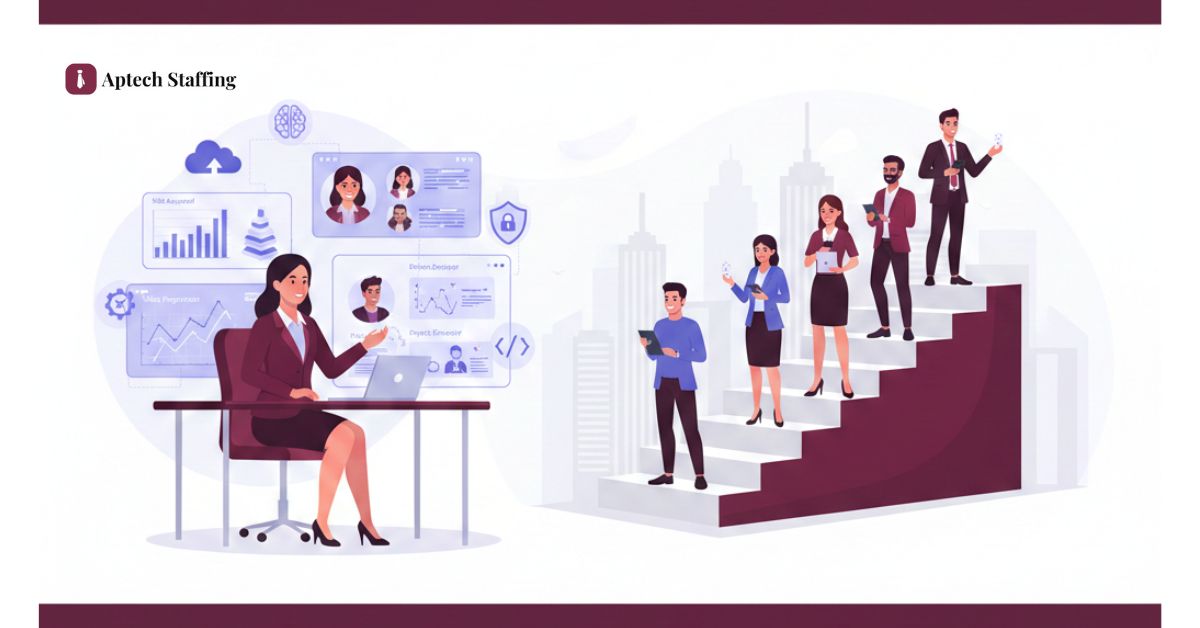
So where does the binary decision come into play? The best in the field insist on polarization avoiding being permanent. They create a career network rather than a career track. It’s a model we’re seeing a lot of at Aptech Staffing, best staffing agency in USA, which we’re calling “the Flexpert” model.
Perhaps you have a full-time job with a solid company with a fixed wage and health benefits. This includes expenses that do not change and helps calm your survivalist. At the same time, you could have a specialized course that you teach online, be a consultant for a single start-up on the weekends, or develop a small SaaS project. The strategy is a gamble, the benefit being the camaraderie and depth that comes with full-time employment plus the income and learning experience provided by freelancing.
Frequently Asked Questions
- How can I be a young professional with a less-than-stellar resume?
If you only see it as a gap. Make it look like you’re operating a consultancy. Emphasize the qualities of the soft skills that corporate recruiters adore like quick turnaround, budget control, and direct communications with clients. Aptech Staffing prepares candidates to get a freelance history and make it as evidence of adaptability instead of instability. - Now that AI has altered tech, is a full-time position safer than freelance?
Safety is not about your contract, it’s about your role in the value chain. One coder who is coding full-time is at greater risk than another architect who is coding as a freelance. Ascend the decision-making hierarchy, and so do security. - I currently am renting and have a mortgage and family to support. Or would it be better not to take the risk of freelancing?
Well, only when you’re not ready. Save for 6-9 months before adopting a child. An even better idea is to investigate an option that combines the best of both worlds: a long-term contract with a single enterprise client. The set of mortgage payments is more predictable, which pays more for freelancing. - What is the chance of me getting mentored as a freelancer?
If you invest in it, otherwise not. Mentorship is served on a platter at full time jobs. For freelance personal brands, it’s a purchase made on purpose, whether it’s paid masterminds or niche coaching or active open source contribution. If you’re not planning on growth, your rates will be stagnant. - What is your worst fear about freelancing?
If you can’t emotionally disconnect from work. When you are working full-time, a bad week is over and so is your paycheck. As a freelancer, your client stressors come with you, no matter where you go. Losing a toxic client can be too difficult to do, so the emotional hit will be more than the monetary gain.